18 Then Jesus came to them and said, “All authority in heaven and on earth has been given to me. 19 Therefore go and make disciples of all nations, baptizing them in the name of the Father and of the Son and of the Holy Spirit, 20 and teaching them to obey everything I have commanded you. And surely I am with you always, to the very end of the age.”
WITH JESUS CAME A NEW COVENANT…. NO LONGER UNDER THE LAW.
HEBREWS 8: 6-9 and more.
6 But now hath he obtained a more excellent ministry, by how much also he is the mediator of a better covenant, which was established upon better promises. 7 For if that first covenant had been faultless, then should no place have been sought for the second. 8 For finding fault with them, he saith, Behold, the days come says the Lord, when I will make a new covenant with the house of Israel and with the house of Judah: 9 Not according to the covenant that I made with their fathers in the day when I took them by the hand to lead them out of the land of Egypt; because they continued not in my covenant, and I regarded them not, saith the Lord. KJV
The reign of King Solomon is a rather bittersweet one. Here he was, the wisest man who had ever lived, ruling over a powerful, wealthy nation at peace, yet the evidence that we glean from Scripture is that his forty-year reign was the prelude to disaster. As Solomon breathes his last breath, the kingdom is poised on the brink of rebellion because of heavy taxation and forced labor (see I Kings 9:20-22; 12:1-5); his heir, Rehoboam, is proud and listens only to his foolish friends (see I Kings 12:6-11); and God has been shunted aside to share glory with a menagerie of other deities (see what happened in Israel immediately after his reign; I Kings 12:25-33).
The Bible provides us both sides of the coin of Solomon's time on the throne of Israel. He presided over Israel's Golden Age and the building of the Temple and a grand palace for the royal family (see I Kings 4:20—8:66). The Queen of Sheba and countless others visited Jerusalem to gaze on the wonders collected there by the king and to hear his wisdom firsthand (see I Kings 4:29-34; 10:1-13). Scripture informs us that gold and silver were as common in Israel's capital as baser metals were elsewhere (I Kings 10:14-23; II Chronicles 9:27). Solomon was so strong and the nations around were so weak that no one dared disturb the peace of the time (except at the very end of his reign; I Kings 11:14-40).
But the underside of the coin is far darker. Though Solomon had been humble as a young man, asking God for understanding so that he could properly rule and judge his people, his pride soon led him to disobedience. He began to flout the instructions given by God through Moses to Israel's kings (Deuteronomy 17:14-20). He made alliances with foreign nations, particularly Egypt, marrying hundreds of domestic and foreign princesses to cement these ties (I Kings 11:1-3). Of course, these women brought their own gods and goddesses to worship, and it was not long before Solomon was honoring their wishes to have various shrines and "high places" built to house their idols (see I Kings 11:4-8).
As usually happens, when the people saw that Solomon had compromised with idolatry, they followed suit, visiting the ancient groves and hilltop altars that had lain unfrequented but not forgotten. Solomon's reign set an unfortunate standard for most of the kings of Judah who followed him, and the people sank deeper into lifestyles contrary to the law of God.
The number forty is frequently a biblical indication of testing. Solomon received forty years from God to see if he would follow His ways or not.
The book of Ecclesiastes indicates that, perhaps at the end of his life, Solomon made an effort to repent—or at least he realized that, in the end, it is a person's chief duty to fear God and keep His commandments (Ecclesiastes 12:13). We really do not know if he passed or failed his test, but we can learn a great lesson from the forty years of his wonderful, terrible reign.
[60:1] “Arise, shine, for your light has come,
and the glory of the LORD rises upon you.
[2] See, darkness covers the earth
and thick darkness is over the peoples,
but the LORD rises upon you
and his glory appears over you.
[3] Nations will come to your light,
and kings to the brightness of your dawn.
[4] “Lift up your eyes and look about you:
All assemble and come to you;
your sons come from afar,
and your daughters are carried on the hip.
[5] Then you will look and be radiant,
your heart will throb and swell with joy;
the wealth on the seas will be brought to you,
to you the riches of the nations will come.
[6] Herds of camels will cover your land,
young camels of Midian and Ephah.
And all from Sheba will come,
bearing gold and incense
and proclaiming the praise of the LORD.
Matthew 2:1-23
[2:1] After Jesus was born in Bethlehem in Judea, during the time of King Herod, Magi from
the east came to Jerusalem [2] and asked, “Where is the one who has been born king of the
Jews? We saw his star when it rose and have come to worship him.”
[3] When King Herod heard this he was disturbed, and all Jerusalem with him.
[4] When he
had called together all the people's chief priests and teachers of the law, he asked them
where the Messiah was to be born.
[5] “In Bethlehem in Judea,” they replied, “for this is
what the prophet has written:
[6] “ ‘But you, Bethlehem, in the land of Judah,
are by no means least among the rulers of Judah;
for out of you will come a ruler
who will shepherd my people Israel.'”
[7] Then Herod called the Magi secretly and found out from them the exact time the star
had appeared. [8] He sent them to Bethlehem and said, “Go and search carefully for the
child. As soon as you find him, report to me, so that I too may go and worship him.”
[9] After they had heard the king, they went on their way, and the star they had seen when
it rose went ahead of them until it stopped over the place where the child was.
[10] When
they saw the star, they were overjoyed.
[11] On coming to the house, they saw the child
with his mother Mary, and they bowed down and worshiped him. Then they opened their
treasures and presented him with gifts of gold, frankincense and myrrh.
[12] And having
been warned in a dream not to go back to Herod, they returned to their country by another
route.
[13] When they had gone, an angel of the Lord appeared to Joseph in a dream. “Get up,” he
said, “take the child and his mother and escape to Egypt. Stay there until I tell you, for
Herod is going to search for the child to kill him.”
[14] So he got up, took the child and his mother during the night and left for Egypt, [15]
where he stayed until the death of Herod. And so was fulfilled what the Lord had said
through the prophet: “Out of Egypt I called my son.”
[16] When Herod realized that he had been outwitted by the Magi, he was furious, and he
gave orders to kill all the boys in Bethlehem and its vicinity who were two years old and
under, in accordance with the time he had learned from the Magi.
[17] Then what was said
through the prophet Jeremiah was fulfilled:
[18] “A voice is heard in Ramah,
weeping and great mourning,
Rachel weeping for her children
and refusing to be comforted,
because they are no more.”
[19] After Herod died, an angel of the Lord appeared in a dream to Joseph in Egypt [20] and
said, “Get up, take the child and his mother and go to the land of Israel, for those who were
trying to take the child's life are dead.”
[21] So he got up, took the child and his mother and went to the land of Israel.
[22] But
when he heard that Archelaus was reigning in Judea in place of his father Herod, he was
afraid to go there. Having been warned in a dream, he withdrew to the district of Galilee,
[23] and he went and lived in a town called Nazareth. So was fulfilled what was said through
the prophets, that he would be called a Nazarene.
Talk
Wise Men, and Joseph, Mary and Jesus, and,
Journeying from the past to the
present and beyond -
Matthew 2:1-23
Introduction
Late last year there were a few jokes around about being able to see clearly in
2020 - how wrong. No one saw what was coming in terms of the pandemic as no one sees
all sorts of events that can happen, good or bad, that have a deep impact on life. The
pandemic is just adding to and exacerbating the more normal unforeseen events of life and
of course has affected just about everyone in the world!
Through our extended reading from Matthew, I want us to follow wise men and Jesus and
family on their journeys and look to what God says to us on our ongoing journeys of life and
faith in the living God through Jesus the Saviour.
As we have moved into a new year just reflect briefly on what 2020 brought and what you
'anticipate' for 2021 but with caution on the latter!
I have six headings
Five start with 'S'
and one nearly does - you'll have to wait for that.
1. Searching - vv 1-6
What is really behind the journey of wise men / magi from probably Babylon to Israel, a
journey of over 900 miles that would take a long time, be difficult and costly?
We are talking
about a journey of nearly 2000 miles with a camel train and taking supplies of tents, food
and water with servants and a whole lot else.
Forget three wise me, yes, three gifts, as we
don't know how many, but there would have been many others and they would have joined
a bigger group, for safety, travelling such a long way. This isn't a trip to the local beach.
They were probably astrologers and although we are warned in the bible against such 'arts'
God can use what he wants for his purposes.
So, something in the heavens made them set
off on this journey but a star in itself seems an inadequate explanation for them to go
seeking a new born 'king of the Jews'.
Could there be something else and most of what follows I say with caution.
First - facts. The Jews had been in Exile in Babylon for something like 70 years.
Ezekiel was speaking to the Jewish exiles there in Babylon and giving them messages from
God along with challenges, encouragement and rebukes!
Daniel, and other 'prime' Jewish youths were initiated into the Royal court where Daniel,
not least had a considerable impact on it and the kings, he was there a long time and of
course Babylon was also taken over by the Assyrians during his time and he had an impact
there too.
All that was 6th and 5th century BC and we read of incredible events of that impact in the
first part of the book.
In the second half there are various prophecies which include references to one to be born
who could be seen as the Messiah, an anointed king for the Jews.
Second, now more speculative, from all of that was something left behind in that court that
these magi picked up and went with and led them to come to search for a King.
Let's face it
they wouldn't make a journey such as theirs unless there were something highly significant
about this particular king. Remember the Jews were the ones held captive and treated
virtually as slaves and this now is something big.
Something goes wrong. They have some guidance yet go to Jerusalem. Was this an example
of one in the group not trusting the GPS star.? Are you with me? There you are driving
along, the Sat Nav says left and a passenger says, no, that's not correct, right!
Someone said, 'Jewish kings live in Jerusalem and that's where we have to go' and they do
and its - wrong!
We can understand why Herod is alarmed, threats to his throne and all the rest' but why the
whole of Jerusalem with him?
Jerusalem was on trade routes from all over, but, first we have these, no doubt, regal men
who may have worn court robes so they looked splendid as they arrived. In addition there
was their entourage and it would have been like the circus coming to town and I don't say
that derisorily but in terms of the spectacular. Also, they are looking for a new born king and
as far as the court in Jerusalem was concerned there wasn't one!
Herod wanted to know the truth, where is the Messiah, God's anointed one, to be born and
his specialist tell him from the book of Micah - Bethlehem.
The journey and the plot continue!
2. Scheming - vv 7-8
Herod, feeling threated, did what many did and do, even though Jesus posed no threat,
prepared a plot to get rid of the opposition. Grizzly, nasty and sick. But, happened and
happens too often - get rid of threats and opposition.
3. Seeing - vv 9-12
They leave and head south from Jerusalem to go to Bethlehem guided by the star - wrong
way for stars to travel - and it stops over the house where the toddler and his family are
living. Yes, Matthew indicates Jesus is no longer a baby but more a toddler by the word he
uses for child. The star GPS did it's job and made it clear where the child was.
They worshipped him - appropriate for the Lord and King of heaven and earth.
They gave gifts that seem prophetic for his life, which would also be valuable in aiding what
was to follow.
They also represent something that the early church would be slow to grasp and that is that
Jesus was not just for Jews but everyone.
Even we struggle with taking Jesus to all!
Then, because of Herod's evil scheme, being warned in a dream, they journey home another
way and don't report back.
However, Herod's evil means Jesus and parents have to embark on a totally unexpected
journey.
4. Escaping - vv 13-15
Joseph is told by God to flee to Egypt with his family and this is a 200 mile plus journey
depending on route and destination.
Here we have something slight odd and seemingly contradictory.
Many of the prophets had
waded the Jews against alliances with the Egyptians because when all is said and done God
took a lot of effort to get them out of Egypt.
Why then did he want Jesus there until Herod was dead?
Surely there were other places just
as safe.
No. You see, God has an eye for detail.
He brought Israel out of Egypt and as we read in
Psalm 80 Israel was the vine he took from Egypt and planted in the land of Israel.
Jesus is the
true vine, the true Israel, John 15. He is the one who is going to be all that Israel never was
to their Lord and God - holy, true to him and totally obedient.
As such, when Jesus returns from Egypt a second Exodus begins which is to have a climax at
the last supper, the Passover celebration, Jesus shared with his disciples the night before
the cross.
The journey to true freedom is now complete and following the cross and resurrection the
way is set for the journey to the ultimate promised land - a new heaven and earth with all
who are in Christ transformed to live in this place by nature of having being given bodies
that are immortal and imperishable.
'Out of Egypt I called my son' - a quote from a very powerful passage in Hosea 11 where
God speaks with maternal passion of his people who he brought from Egypt but who
refused to take him seriously.
Jesus is called out of Egypt when Herod died and so fulfilled this longing of God for one who
would be faithful and obedient which Jesus was - even to death on a cross - the faithful and
true servant of the Lord.
The magi journeying home without seeing Herod led to something terrible, namely
5. Slaughtering - vv 16-18
This is the most ghastly part of the birth narratives which is truly shocking. It is also another
indicator of the age of Jesus at the arrival of the magi - under two and under two year old
boys suffered because of enraged and jealous king who wanted rid of any potential rival and
stopped at nothing to achieve it.
Of course, there was no rival and what he did was a pointless waste of life but then some
years later his brother was to be complicit in the death of Jesus and later still of others in
the early church.
6. Settling - vv 19-23
The text tells us their reasoning for going back to Nazareth although it could appear that it
was a sudden choice.
Of course we know, from Luke, the family were from Nazareth and
went to Bethlehem with good reason. Matthew's readers don't know that bit so he just tells
them this is where they went to live. This part of the journey keeps them well out of the way of the latest in line of the
Jewish royal family and in a place where Jesus can grow up in safety and enjoying a good
number of years of what we might call 'normal human life' before embarking on the next
part of his journey.
Conclusion
We have followed two sets of journeys and I hope that may cause us to reflect on those we
are involved in and relating that to our journey of faith.
The first was of the magi following 'guidance' that could have turned out to be a wild goose
chase. Perhaps there are times we think we may be being guided by God in a particular long
and arduous journey. How do we know if it is right? Perhaps, by seeing where we end up or
if we draw real blanks by looking afresh at what he is saying.
The second is Mary and Joseph with their little guy and fleeing to Egypt as a result of a
dream but in obedience to God. Did they ever find out the actual atrocity of Bethlehem? I
suspect they did but only after they settled back in Nazareth.
Sometime we wonder why things have happened and want to know. Sometimes we see
dimly, other times clearly and yet others, nothing.
Walking with God our Father, in faith, can be risky, costly and sometimes we feel astray.
We are called to trust and obey so how do we react when we feel called?
Plump for safety
or take the step of faith and go and then see . . .
I note - Human nature is prone to take the least line of resistance!
Jesus took up a cross for us out of faith and obedience and said, for my sake and that of the
kingdom, do similarly if you want to follow me.
Yet too often we, and the church, sit
comfortably and conservatively - that's how we've always done it, no point changing now!
What new opportunities are we personally going to have to grasp in 2021? Who knows but
will we still have to face and handle what comes?
Who knows what is going to happen to them in 2021? We might rather not know, but how
will we handle what comes?
On whom will we rely to lead and who will we keep on
following through thick and thin?
Only God our Father is the one to ultimately trust in all matters even though we value and
seek the guidance and counsel of our fellow brothers and sisters in Christ.
What will the Church face, what will your church face, what will this chaplaincy face?
Let's
not try and guess, but rise with faith in him who has only good things for those who love
him and have been called according to his purposes. (Rom 8:28)
The day you and I said in response and commitment to God, in Jesus name, 'my life is yours
whatever you want I will do it' (they were mine - what were yours) we started on a journey.
As Christians we are part of a family, the church, and with fellow Christians we are involved
in various journeys.
Like the magi, like Mary and Joseph, we step out in faith and love with our heavenly Father
under the guiding of the Holy Spirit in obedience to Jesus and keep on going with this
journey remembering that we are to bring glory to God who has called us
1. Saved to be called - birth of Moses and his early upbringing
2. Called to speak - God's call for him to go to back to Egypt so that the Children of Israel
an be released.
3. Speaking to Confront - Confronting Pharaoh and the powers behind the throne that
were holding the Children of Israel in slavery with all the suffering and cruelty it
brought.
Today:
Confronting for Victory -
Exodus 11:4-8;
Exodus 12:1-13 & 29-32
Introduction
I am leaving it to you to read the account of the plagues in full. Last week we left as the Nile
was turned to blood, we noted that the court magicians backed off at the 4th plague, that of
gnats and today we pick up at the last plague as the Lord hits hard and secures the release
of his chosen people and prepares to put them on the path to the land of promise.
We can also note now that from the 5th plague he only allows the Egyptians to be affected
and not the area where the Israelites lived.
This again shows more of the sovereignty of
God.
Egypt is being hit hard and paying a high price for the evil inflicted on the Israelites in their
enforced slavery the stubborn and hard heart of the king who just keeps changing his mind
and won't see the power of the Lord.
Let's remember the Children of Israel are God's chosen
people who are a people with a promise. They are also a nation formed through promise to
Abram.
They are also going to be called to be faithful to the promise and to sole allegiance the Lord.
Failure will then put them in trouble and more!
Perhaps Pharaoh symbolises many people through the ages right down until today whose
minds are against seeing the hand of God and not least in and through the full ministry of
Jesus. Much is said to try and destroy and rubbish the message. Christians are persecuted
harshly in many parts of the world and more subtly in others. This has gone on for centuries.
People still fail to see that the power of God, working through the gospel, moves on and
cannot be overthrown or stopped.
Don't lose heart when people accuse you, put down your Christian beliefs or belittle the
message of the cross. It is to be expected.
Exodus 11:4-8 - The Lord announces the final plague
[4] So Moses said, “This is what the LORD says: ‘About midnight I will go throughout Egypt.
[5] Every firstborn son in Egypt will die, from the firstborn son of Pharaoh, who sits on the
throne, to the firstborn son of the female slave, who is at her hand mill, and all the firstborn
of the cattle as well. [6] There will be loud wailing throughout Egypt—worse than there has
ever been or ever will be again. [7] But among the Israelites not a dog will bark at any
person or animal.' Then you will know that the LORD makes a distinction between Egypt and
Israel. [8] All these officials of yours will come to me, bowing down before me and saying,
‘Go, you and all the people who follow you!' After that I will leave.” Then Moses, hot with
anger, left Pharaoh.
Consider, before we see more:
God judges sin and evil, and he rights wrongs - this is tough but how tough given what his
chosen ones were going through?
Think the cross - we shall look at it soon
Exodus 12:1-13 & 29-32 - Preparation for the Children of Israel to leave
including the Passover lamb, it's bloody and the terrible 10th plague on Egypt
[12:1] The LORD said to Moses and Aaron in Egypt, [2] “This month is to be for you the first
month, the first month of your year. [3] Tell the whole community of Israel that on the tenth
day of this month each man is to take a lamb for his family, one for each household. [4] If
any household is too small for a whole lamb, they must share one with their nearest
neighbour, having taken into account the number of people there are. You are to determine
the amount of lamb needed in accordance with what each person will eat. [5] The animals
you choose must be year-old males without defect, and you may take them from the sheep
or the goats. [6] Take care of them until the fourteenth day of the month, when all the
members of the community of Israel must slaughter them at twilight. [7] Then they are to
take some of the blood and put it on the sides and tops of the doorframes of the houses
where they eat the lambs. [8] That same night they are to eat the meat roasted over the
fire, along with bitter herbs, and bread made without yeast. [9] Do not eat the meat raw or
boiled in water, but roast it over a fire—with the head, legs and internal organs. [10] Do not
leave any of it till morning; if some is left till morning, you must burn it. [11] This is how you
are to eat it: with your cloak tucked into your belt, your sandals on your feet and your staff
in your hand. Eat it in haste; it is the LORD's Passover.
[12] “On that same night I will pass through Egypt and strike down every firstborn of both
people and animals, and I will bring judgment on all the gods of Egypt. I am the LORD. [13]
The blood will be a sign for you on the houses where you are, and when I see the blood, I
will pass over you. No destructive plague will touch you when I strike Egypt.
[29] At midnight the LORD struck down all the firstborn in Egypt, from the firstborn of
Pharaoh, who sat on the throne, to the firstborn of the prisoner, who was in the dungeon,
and the firstborn of all the livestock as well. [30] Pharaoh and all his officials and all the
Egyptians got up during the night, and there was loud wailing in Egypt, for there was not a
house without someone dead.
[31] During the night Pharaoh summoned Moses and Aaron and said, “Up! Leave my people,
you and the Israelites! Go, worship the LORD as you have requested. [32] Take your flocks
and herds, as you have said, and go. And also bless me.”
Observe:
We are now at the critical moment of God's rescue plan that he announced he would
accomplish when he spoke to Moses at the burning bush
Ex 3:7-8. Salvation is about to be
delivered.
It is accompanied by a solemn, and carefully planned, celebratory meal which involved a
lamb to be eaten along with bitter herbs and bread made without yeast - a hasty meal.
It is
known as The Passover and the Children of Israel are told to celebrate it annually to remind
them of the mighty way in which they were brought out of Egypt at the hand of the Lord -
those details are later in this chapter.
A serious injunction - the blood of the lambs, v7, is to be 'put on the sides and tops of the
doorframes of the houses where they eat the lambs'.
Why? Look at v 13, The blood will be a sign for you on the houses where you are, and
when I see the blood, I will pass over you. No destructive plague will touch you when I
strike Egypt
Why is the Lord striking Egypt?
The verse before, I will bring judgment on all the gods of
Egypt. I am the LORD.
The clear teaching of scripture is that there is but one true and living God - the Lord and all
other so-called god's are nothing. As such they are powerless and unable to do anything -
the Lord is showing what he can do, and, he hasn't finished yet!
A matter of note too about the use of the blood - they are told / invited to do it, not made
to. Not to do this would have had serious consequences in that they would suffer the same
fate as the rest of Egypt!
See also in the record of this terrible plague, vv 29-30, there is no gloating only a straight
record of the horror of what happened!
Finally, on this hear again the words of Pharaoh to Moses and Aaron having summoned
their presence, “Up! Leave my people, you and the Israelites! Go, worship the LORD as you
have requested. [32] Take your flocks and herds, as you have said, and go. And also bless
me.”
And yes, the people up and off they go. There is a victory over the gods of Egypt and after
this they are able to set off on the road to freedom - but Pharaoh isn't done yet but that's
next week.
I now hasten to remind us that Salvation, victory and the way to freedom comes at a high
price and so we pass to our next, but not final, reading.
Mark 15:15 & 33-39 - the agony of the cross
[15] Wanting to satisfy the crowd, Pilate released Barabbas to them. He had Jesus flogged,
and handed him over to be crucified.
[33] At noon, darkness came over the whole land until three in the afternoon. [34] And at
three in the afternoon Jesus cried out in a loud voice, “Eloi, Eloi, lema sabachthani?” (which
means “My God, my God, why have you forsaken me?”).
[35] When some of those standing near heard this, they said, “Listen, he's calling Elijah.”
[36] Someone ran, filled a sponge with wine vinegar, put it on a staff, and offered it to Jesus
to drink. “Now leave him alone. Let's see if Elijah comes to take him down,” he said.
[37] With a loud cry, Jesus breathed his last.
[38] The curtain of the temple was torn in two from top to bottom. [39] And when the
centurion, who stood there in front of Jesus, saw how he died, he said, “Surely this man was
the Son of God!”
The Price of Salvation, Victory and Freedom
Very few details of the Passion of Jesus are given, they weren't needed, and again what we
read includes extreme and cruel treatment.
Flogging - this was the scourge and multi tailed whip with bone and metal on the flails. It
could kill! Jesus was also mocked and spat upon as we see in other parts of the account.
Crucifixion - one of the cruellest forms of execution. Anyone in the ancient Roman world
would know what it was like because it was a common and public event aimed at creating
fear.
Jesus went through that out of God's love to rescue us from sin and death and it is
guaranteed but, as the Israelites had to put the blood on their doorposts - they had to
respond or suffer the same consequences as the Egyptians, each of us, and others who want
the benefits of the cross, have to respond as it is not automatic.
The benefits are being part of the Kingdom of God. His kingdom is breaking in, and, as part
of it, we live under the sovereignty of God being surrounded by His saving love and being his
servants to foster the growth and presence of that self-same kingdom.
We are also headed
for the promised land - more next week.
I hope we understand that Jesus is not just the Good Shepherd but also the lamb of God
who takes away the sin of the world because that was laid on him and we hear that in his
cry of dereliction - v 34, where he was totally abandoned by God.
It is a quote from the
opening of Psalm 22 and when you read, or reread it, it is amazing.
Isaiah 53 is also worth reading again, written centuries before Jesus, and I am limiting myself
to sharing 2 verses- vv 4-5
[4] Surely he took up our pain
and bore our suffering,
yet we considered him punished by God,
stricken by him, and afflicted.
[5] But he was pierced for our transgressions,
he was crushed for our iniquities;
the punishment that brought us peace was on him,
and by his wounds we are healed.
And because I mentioned lamb of God, I realised I ought to include v 7 as well:
[7] He was oppressed and afflicted,
yet he did not open his mouth;
he was led like a lamb to the slaughter,
and as a sheep before its shearers is silent,
so he did not open his mouth.
So I want us to pause and reflect on our, yours and mine, encounter with Jesus at the cross.
I want us to reflect on our response to it and so our personal commitment to the Lord Jesus
- the personal relationship we have with him.
Of course, the Passover was a shared meal because God's people belong together and in
Christ, we are his body which is a corporate entity, so, we now look at the narrative of
Luke 22:14-20 - the events of the night before the cross as Jesus celebrated
the Passover with the 12
[14]
When the hour came, Jesus and his apostles reclined at the table. [15] And he said to
them, “I have eagerly desired to eat this Passover with you before I suffer. [16] For I tell you,
I will not eat it again until it finds fulfillment in the kingdom of God.”
[17] After taking the cup, he gave thanks and said, “Take this and divide it among you. [18]
For I tell you I will not drink again from the fruit of the vine until the kingdom of God
comes.”
[19] And he took bread, gave thanks and broke it, and gave it to them, saying, “This is my
body given for you; do this in remembrance of me.”
[20] In the same way, after the supper he took the cup, saying, “This cup is the new
covenant in my blood, which is poured out for you.
All Change, All New
Remember, when Jesus has told his disciples he was to suffer, die and rise again, they really
struggled. It didn't fit in with what they expected.
In what Jesus says here, well, they must have been even more bewildered and as far as I can
see this is the only place where Jesus spells out in some detail the significance of his
suffering and the cross, which we have just looked at.
There is something briefer in Mark
10:45
For even the Son of Man did not come to be served, but to serve, and to give his life as a
ransom for many.”
But that's about it and here the significance of what he says is that the cross, next day, is the
new and definitive rescue leading to salvation, victory and freedom. The start to the new
exodus, the start to the road to the promised land, that is, the new heaven and earth which
is the restoration after the fall, Genesis 3, when Adam and Eve said 'no' to God's only
command and rejected him. Jesus is the second Adam who says 'yes' to God in the garden of
Gethsemane just before he was betrayed and 'handed over' to the arresting party and so
accepted the way to salvation, victory, freedom and life etc.
When we share bread and wine, we participate in all of this . . . .
And more! It is the meal
where we recall, with deep thanksgiving, our salvation and recreation in the here and now
which is finalised completely when Jesus returns.
Again, a brief quiet to reflect as we come to share bread and wine in our Agape.
Two births - Moses and Jesus, separated by centuries but overlapping in the purposes of
God in the deliverance and salvation of his people.
This month we are going to follow the early chapters of Exodus up to the crossing of the Red
Sea using 'selected' passages to trace this journey of deliverance and I will seek to fill in
some of the details as we go. As often I would encourage you to read, not only along, but
the first 15 chapters. I am still working on the passages I shall use.
I also intend to include some contrasting and complementary passages from the life of Jesus
as I am doing today.
One big thing we will see, at least, is that as the children of Israel leave Egypt God institutes
and tells them to celebrate the Passover. Part of that was that they are to save from death
by the blood of lambs on their doorposts as the angel of death goes over killing firstborn
males, human and animal, across the whole land of Egypt. On the night before the cross,
Jesus the lamb of God who takes away the sin of the world and delivering all who repent
and believe in him from death, celebrated the Passover meal and gave it a transformed
1. Changing Circumstances - a 400 year synopsis! Ex 1:1-14
[1:1] These are the names of the sons of Israel who went to Egypt with Jacob, each with
his family: [2] Reuben, Simeon, Levi and Judah; [3] Issachar, Zebulun and Benjamin; [4]
Dan and Naphtali; Gad and Asher. [5] The descendants of Jacob numbered seventy in all;
Joseph was already in Egypt.
[6] Now Joseph and all his brothers and all that generation died, [7] but the Israelites were
exceedingly fruitful; they multiplied greatly, increased in numbers and became so
numerous that the land was filled with them.
[8] Then a new king, to whom Joseph meant nothing, came to power in Egypt. [9] “Look,”
he said to his people, “the Israelites have become far too numerous for us. [10] Come, we
must deal shrewdly with them or they will become even more numerous and, if war
breaks out, will join our enemies, fight against us and leave the country.”
[11] So they put slave masters over them to oppress them with forced labour, and they
built Pithom and Rameses as store cities for Pharaoh. [12] But the more they were
oppressed, the more they multiplied and spread; so the Egyptians came to dread the
Israelites [13] and worked them ruthlessly. [14] They made their lives bitter with harsh
labour in brick and mortar and with all kinds of work in the fields; in all their harsh labour
the Egyptians worked them ruthlessly.
Four hundred - round figures at this stage, as in total, when they leave, the children of Israel
had been in Egypt for 430 years (Ex 12:40) and at that stage Moses is 80 years old according
to Stephen's speech in Acts 7: 23 & 30 and that he was 40 when he fled Egypt and 80 when
he returns to 'confront' Pharaoh.
When Joseph brought his family to Egypt at the time of severe famine he was, as you may
recall, 2nd in command to Pharaoh so an extremely high-ranking person. Times radically
changed and from privilege the people of Israel have been reduced to extreme servitude
and indeed growing cruelty. They were also rapidly growing in numbers and the Egyptians
were getting fearful of the ethnic minority!
Sounds to familiar in the history of the world through the ages and indeed today - we need
to pray for, and act as we can, those in similar circumstances who are subjected to abuse,
misunderstanding and cruelty.
Fear, we see, leads to worse.
2. Extreme measures and disobedience borne out of fear! Ex 1:15-21
[15] The king of Egypt said to the Hebrew midwives, whose names were Shiphrah and
Puah, [16] “When you are helping the Hebrew women during childbirth on the delivery
stool, if you see that the baby is a boy, kill him; but if it is a girl, let her live.” [17] The 1. Changing Circumstances - a 400 year synopsis! Ex 1:1-14
[1:1] These are the names of the sons of Israel who went to Egypt with Jacob, each with
his family: [2] Reuben, Simeon, Levi and Judah; [3] Issachar, Zebulun and Benjamin; [4]
Dan and Naphtali; Gad and Asher. [5] The descendants of Jacob numbered seventy in all;
Joseph was already in Egypt.
[6] Now Joseph and all his brothers and all that generation died, [7] but the Israelites were
exceedingly fruitful; they multiplied greatly, increased in numbers and became so
numerous that the land was filled with them.
[8] Then a new king, to whom Joseph meant nothing, came to power in Egypt. [9] “Look,”
he said to his people, “the Israelites have become far too numerous for us. [10] Come, we
must deal shrewdly with them or they will become even more numerous and, if war
breaks out, will join our enemies, fight against us and leave the country.”
[11] So they put slave masters over them to oppress them with forced labour, and they
built Pithom and Rameses as store cities for Pharaoh. [12] But the more they were
oppressed, the more they multiplied and spread; so the Egyptians came to dread the
Israelites [13] and worked them ruthlessly. [14] They made their lives bitter with harsh
labour in brick and mortar and with all kinds of work in the fields; in all their harsh labour
the Egyptians worked them ruthlessly.
Four hundred - round figures at this stage, as in total, when they leave, the children of Israel
had been in Egypt for 430 years (Ex 12:40) and at that stage Moses is 80 years old according
to Stephen's speech in Acts 7: 23 & 30 and that he was 40 when he fled Egypt and 80 when
he returns to 'confront' Pharaoh.
When Joseph brought his family to Egypt at the time of severe famine he was, as you may
recall, 2nd in command to Pharaoh so an extremely high-ranking person. Times radically
changed and from privilege the people of Israel have been reduced to extreme servitude
and indeed growing cruelty. They were also rapidly growing in numbers and the Egyptians
were getting fearful of the ethnic minority!
Sounds to familiar in the history of the world through the ages and indeed today - we need
to pray for, and act as we can, those in similar circumstances who are subjected to abuse,
misunderstanding and cruelty.
Fear, we see, leads to worse.
2. Extreme measures and disobedience borne out of fear! Ex 1:15-21
[15] The king of Egypt said to the Hebrew midwives, whose names were Shiphrah and
Puah, [16] “When you are helping the Hebrew women during childbirth on the delivery
stool, if you see that the baby is a boy, kill him; but if it is a girl, let her live.” [17] The
1. Changing Circumstances - a 400 year synopsis! Ex 1:1-14
[1:1] These are the names of the sons of Israel who went to Egypt with Jacob, each with
his family: [2] Reuben, Simeon, Levi and Judah; [3] Issachar, Zebulun and Benjamin; [4]
Dan and Naphtali; Gad and Asher. [5] The descendants of Jacob numbered seventy in all;
Joseph was already in Egypt.
[6] Now Joseph and all his brothers and all that generation died, [7] but the Israelites were
exceedingly fruitful; they multiplied greatly, increased in numbers and became so
numerous that the land was filled with them.
[8] Then a new king, to whom Joseph meant nothing, came to power in Egypt. [9] “Look,”
he said to his people, “the Israelites have become far too numerous for us. [10] Come, we
must deal shrewdly with them or they will become even more numerous and, if war
breaks out, will join our enemies, fight against us and leave the country.”
[11] So they put slave masters over them to oppress them with forced labour, and they
built Pithom and Rameses as store cities for Pharaoh. [12] But the more they were
oppressed, the more they multiplied and spread; so the Egyptians came to dread the
Israelites [13] and worked them ruthlessly. [14] They made their lives bitter with harsh
labour in brick and mortar and with all kinds of work in the fields; in all their harsh labour
the Egyptians worked them ruthlessly.
Four hundred - round figures at this stage, as in total, when they leave, the children of Israel
had been in Egypt for 430 years (Ex 12:40) and at that stage Moses is 80 years old according
to Stephen's speech in Acts 7: 23 & 30 and that he was 40 when he fled Egypt and 80 when
he returns to 'confront' Pharaoh.
When Joseph brought his family to Egypt at the time of severe famine he was, as you may
recall, 2nd in command to Pharaoh so an extremely high-ranking person. Times radically
changed and from privilege the people of Israel have been reduced to extreme servitude
and indeed growing cruelty. They were also rapidly growing in numbers and the Egyptians
were getting fearful of the ethnic minority!
Sounds to familiar in the history of the world through the ages and indeed today - we need
to pray for, and act as we can, those in similar circumstances who are subjected to abuse,
misunderstanding and cruelty.
Fear, we see, leads to worse.
2. Extreme measures and disobedience borne out of fear! Ex 1:15-21
[15] The king of Egypt said to the Hebrew midwives, whose names were Shiphrah and
Puah, [16] “When you are helping the Hebrew women during childbirth on the delivery
stool, if you see that the baby is a boy, kill him; but if it is a girl, let her live.” [17] The
22 “How great you are, Sovereign Lord! There is no one like you, and there is no God but you, as we have heard with our own ears.
23 And who is like your people Israel—the one nation on earth that God went out to redeem as a people for himself, and to make a name for himself, and to perform great and awesome wonders by driving out nations and their gods from before your people, whom you redeemed from Egypt?[d]
24 You have established your people Israel as your very own forever, and you, Lord, have become their God.
25 “And now, Lord God, keep forever the promise you have made concerning your servant and his house. Do as you promised, 26 so that your name will be great forever. Then people will say, ‘The Lord Almighty is God over Israel!’ And the house of your servant David will be established in your sight.
27 “Lord Almighty, God of Israel, you have revealed this to your servant, saying, ‘I will build a house for you.’ So your servant has found courage to pray this prayer to you. 28 Sovereign Lord, you are God! Your covenant is trustworthy, and you have promised these good things to your servant. 29 Now be pleased to bless the house of your servant, that it may continue forever in your sight; for you, Sovereign Lord, have spoken, and with your blessing the house of your servant will be blessed forever.”
2 Samuel 7:23See Septuagint and 1 Chron. 17:21; Hebrew wonders for your land and before your people, whom you redeemed from Egypt, from the nations and their gods.
Within the list of faith champions in Hebrews 11, Rahab is mentioned right after Moses, and instead of Joshua! It was by faith that Rahab the prostitute was not destroyed with the people in her city who refused to obey God. For she had given a friendly welcome to the spies. Hebrews 11:31Source
Joshua 2
1 Then Joshua son of Nun secretly sent two spies from Shittim. “Go, look over the land,” he said, “especially Jericho.” So they went and entered the house of a prostitute named Rahab and stayed there.
2 The king of Jericho was told, “Look, some of the Israelites have come here tonight to spy out the land.” 3 So the king of Jericho sent this message to Rahab: “Bring out the men who came to you and entered your house, because they have come to spy out the whole land.”
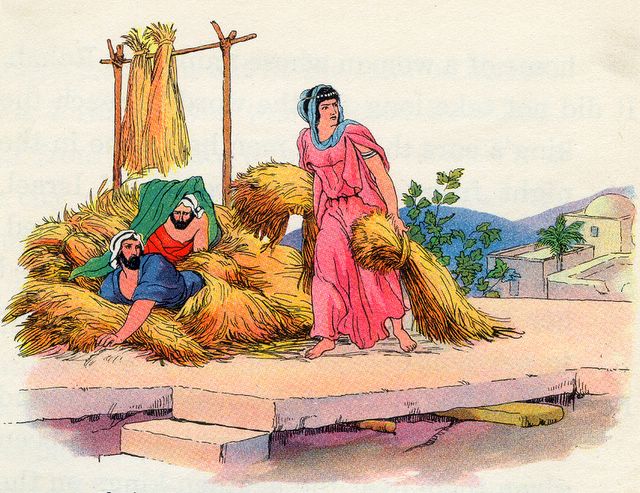
4 But the woman had taken the two men and hidden them. She said, “Yes, the men came to me, but I did not know where they had come from. 5 At dusk, when it was time to close the city gate, they left. I don’t know which way they went. Go after them quickly. You may catch up with them.” 6 (But she had taken them up to the roof and hidden them under the stalks of flax she had laid out on the roof.) 7 So the men set out in pursuit of the spies on the road that leads to the fords of the Jordan, and as soon as the pursuers had gone out, the gate was shut.
8 Before the spies lay down for the night, she went up on the roof 9 and said to them, “I know that the Lord has given you this land and that a great fear of you has fallen on us, so that all who live in this country are melting in fear because of you. 10 We have heard how the Lord dried up the water of the Red Sea for you when you came out of Egypt, and what you did to Sihon and Og, the two kings of the Amorites east of the Jordan, whom you completely destroyed. 11 When we heard of it, our hearts melted in fear and everyone’s courage failed because of you, for the Lord your God is God in heaven above and on the earth below.
Because Rahab believed that Jehovah God is the “God, in heaven above and on earth beneath” she disobeyed the king of Jericho and hid the two spies. She was willing to do that because they served God whom she recognised and respected as the true God. Source
Lyrics @ translation in English
Dawart kteer-ala shei yes-edni
(I searched alot to find something to make me happy)
Hawelt alaai-haga teshbe'ni
(Tries to find some thing that could satisfy me)
wfdelt tayeh,fe al-donia hayem
(but i went lost, wandering in this world,)
Albi lessa atshaan
(my heart was still empty and thirsty.
seme't wahed, bynadini. Aal:" taal,emsek beidi.
Ana arfak, d-Ana khalaak. Ana hases beek
(I heard some one calling my name told me to hold his hand ,i know you,i created you ,i felt your pain ) w gait ashanak ya habibi, mott badalak ala al -salib ,Wahabtak hayah
(i came for you o my beloved,i died for you on the cross , i gifted you this life)
W edetak nagah.Kol znobak maghfoora laka.
(i gave you salvation and all your sins are forgiven) w shoft eiydo mamdoda leya ,Bellamsa SHAFYA FATAH ENAYA.nawar tari'y.Ghayar hayaty.
(and i saw his hands reaching out for me,with healing touch he open my eyes,he shed light on path and changed my life)
Ana eli kont be-eid (i was gone too far away..)
Ezay makontesh shayf rabbi?
(How ,i couldn't see my lord)
w kont aiyesh men ghero gambi?
(how did i live with out him,stays beside me?)
Rakaat odamo ,w mesikt fe eiydo.sarakh-t baala soaat........
(i knwlt down before him,i hold his hand,i cried out him....loudly) Hayaty tebaa leek al-youm
(today ,my life belongs to you lord)
Tesh- had aan Yasua w twool,Howa da al-Tareek,
(to bear witness to jesus , to say .."he is the way")
w hoa al-Maleek.Howa da Elah-i-al-abady
(He is the king,He is my eternal God)
Taala w sallem hayatak odamo .Da howa Elah-ak
(Come and surrender your life to him ,He is your God,)
W hases be halak.Hayedeelak awowa,w yedeelak norsra ala kol kh -atya.Matrannem maaya
(grant you victory ,over every sin,come sing with me,) Hayaty tebaa leek al-youm
(Today ,my life belongs to you lord)
Tesh- had aan Yasua w twool,Howa da al-Tareek,
(to bear witness to jesus , to say .."he is the way")
w hoa al-Maleek.Howa da Elah-i-al-abady
(He is the king,He is my eternal God)..