Showing posts with label Christian beliefs. Show all posts

22/07/2019

At calvary!


A beautiful worship song 
Courtesy of Susan Tuck

Calvary

Thank you Lord, you bore the pain
You wore the crown, took all my shame
And thank you Lord, you died for me
Upon that cross at Calvary

Chorus
At Calvary, at Calvary
You took my sin and set me free
And now I live to worship thee

Thank you Lord, that I should know
The Son of God, Your Love to show
And thank you that you died for me
To set this lonely sinner free

Chorus

Risen Lord, eternal King
God’s only Son, above all things
I bow before Your heavenly throne
And seek Your kingdom, eternal home

Chorus


13/06/2016

Hope in the name of Jesus!

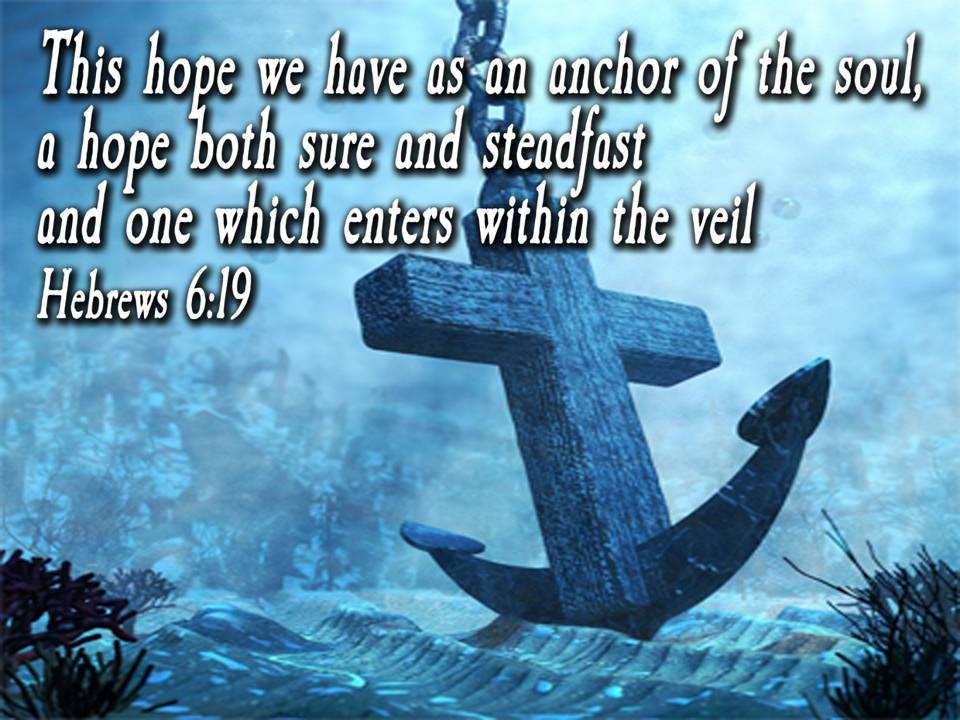
Anchor of our soul
Even youths (teenagers) grow tired and weary, and young men stumble and fall; 
but those who hope in the Lord will renew their strength.
They will soar on wings like eagles;
they will run and not grow weary, 
they will walk and not be faint. 

Isaiah 40:30-31

God’s Chosen Servant

15 Aware of this, Jesus withdrew from that place. A large crowd followed him, and he healed all who were ill.
 16 He warned them not to tell others about him.
 17 This was to fulfill what was spoken through the prophet Isaiah:
18 “Here is my servant whom I have chosen,
the one I love, in whom I delight;
I will put my Spirit on him,
and he will proclaim justice to the nations.
19 He will not quarrel or cry out;
no one will hear his voice in the streets.
20 A bruised reed he will not break,
and a smoldering wick he will not snuff out,
till he has brought justice through to victory.
21 In his name the nations will put their hope.”

Matthew 12:15-21

02/10/2015

God pointing...Spirit leading..Kingdom coming..


‘Spirit-led Discipleship’
Leader: George Fisher

One of the ‘in’ words at the moment is discipleship, and rightly so. However, in most teaching and training on discipleship the Holy Spirit is hardly ever mentioned. This workshop will examine the vital role of the Holy Spirit in our discipleship and explore how being more open to the Spirit leads us to become effective disciples of Jesus.

‘Hearing & discerning the voice of God’
Leader: Tim Storey

In a world of noise and 24/7 information coming at us from all directions, it is increasingly hard to hear the still small voice of God. Whilst we may be able to take time out to go where it is quiet for a while, what about the rest of the time? Come along and let’s work out together how we can make sure God doesn’t just get a word in edgeways but that His voice is loud and clear in our lives each day.

‘Healing of past hurts’
Leader: Ali Summers

Discovering the inner journey of wholeness, freedom and intimacy that Jesus invites us into. We will explore some of the available prayer models which help us to find breakthrough in identifying lies and choosing forgiveness and healing.

‘Engaging in Worship’
Leader: Matt Hird

We will be exploring what engaging in worship means outside of the big events and conferences – how can we experience spirit-filled worship without a big band? There will be an opportunity to share insights as well as some practical tips for creating space for worshippers to encounter the Holy Spirit. Come willing to share and to receive.

‘Restoring the Apple’
Leaders: John Alessi and Carl Washington

It is often the case that the ministry of deliverance, particularly in the church in the West, is viewed with suspicion. It can seem archaic and weird, but the reality is quite the opposite, there are very powerful spiritual, emotional, and psychological dynamics that need to be addressed. If we are to see the glory of God in our communities we have to get the deliverance ministry back into the mainstream of the church, where it is seen as a component part of the body of Christ. In the ministry of Jesus, his deliverance ministry is one of the most outstanding features of his time on earth, and so it should be for us. The workshop will challenge our thinking of a ministry that is often overlooked

04/02/2015

'I began to realise that the case for Christianity was very, very strong..'

Why Muslim Dr. Nabeel Qureshi Converted to Christianity
Dr. Nabeel Qureshi is a former devout Muslim who was convinced of the truth of the Gospel through historical reasoning and a spiritual search for God. Since his conversion, he has dedicated his life to spreading the Gospel through teaching, preaching, writing, and debating. 
Nabeel has given lectures at universities and seminaries throughout North America, including New York University, Rutgers, the University of North Carolina, the University of Ottawa, Eastern Virginia Medical School, Southern Baptist Theological Seminary, and Biola University. He has participated in 17 moderated, public debates around North America, Europe, and Asia. His focus is on the foundations of the Christian faith and the early history and teachings of Islam.


24/01/2015

Why I left Islam to follow Jesus

Former Muslim Nabeel Qureshi explains how his search for the truth about Jesus in scripture led to his conversion.
Contrast is the mother of clarity. So says author Os Guinness, and this principle is what ultimately led me away from Islam and towards the gospel. 
As a young Muslim in the West, our community very intentionally defended me against Christianity, the majority religion. The first verses of the Koran that I and the other young children at our mosque memorised proclaimed that God is neither Father nor Son (based on Surah 112:3).  
Traditions informed us that this teaching makes up a third of the Koran (Sahih Muslim 812), so we recited it every day. By the age of six, I had recited, ‘God is not a Father, God is not a Son’ thousands of times. It is no wonder I became a bold opponent of the Trinity.  
We were also taught that Muhammad was God’s greatest messenger; the most perfect man who ever lived. We learnt the story of his life and did our utmost to follow it. We emulated him to such a degree that we even attempted to walk into   the lavatory the way he did. The reverence we accorded him was barely secondary to our reverence for Allah.
Although Islam teaches that the Bible and the Koran originated from God, we were effectively instructed that they were polar opposites: the Bible has been polluted, the Koran remains pristine; the Bible is partially the word of man, the Koran is purely the word of God; the Bible contains contradictions, the Koran is completely coherent; the Bible leads to confusion, the Koran leads to life.
So, as a young Muslim I ardently called others to the way of Islam. I was certain of its truth. My confidence in Islam translated into zeal for Allah, Muhammad, the Koran and sharia. But contrast is the mother of clarity.

DOUBTING THE KORAN

I met a young Christian named David, and we quickly became firm friends due to our common morals and devotion. The time came when I challenged him on the reliability of the Bible, and I had finally met someone who was equipped to defend his faith.  
Ultimately, he challenged me to contrast the history of the Bible with that of the Koran. It was then that I discovered there had been so much dispute over the Koran early in its history that an official edict established one standard Koran and ordered all the rest destroyed (Sahih Bukhari 6:61:509-510). There was no occasion for the Bible to have been officially altered throughout Christendom, but there was certainly occasion for the Koran to have been modified throughout the House of Islam, and records remain of old variants that testify to former versions.
While discussing the Bible and the Koran, I also challenged David on the divine authority of Jesus. He responded to my points, but he also challenged me to contrast my arguments with a case for the authority of Muhammad. It was then that I realised my standards for criticising the origins of Christianity would raze the foundations of Islam if I applied them consistently.  
Though I doubted the reliability of the Gospels, written in the lifetime of Jesus’ disciples, the entire edifice of the Sirah (various traditional Muslim biographies of Muhammad) rested on accounts from 150-250 years after his death. The earliest account of Muhammad’s life is only known to us because one devout Muslim preserved it, and he uses no uncertain words to say that what he received contained fabrications and false reports (Ibn Hisham, who edited Ibn Ishaq’s Sirah Rasul Allah).  
By contrast, the case for Jesus’ death, deity and resurrection was very strong, built on early records that were most coherently explained by orthodox Christian positions. It was through this contrast that matters became clear. 

THE CASE FOR CRUCIFIXION  

While still contemplating these issues as a Muslim, I attended a debate between a Christian called Michael Licona and a Muslim called Shabir Ally on the topic of Jesus’ resurrection. A trend in Ally’s thinking emerged through the course of the debate, and what I saw shook me.  
Multiple ancient sources report Jesus’ death by crucifixion, including Jewish, Gentile, and Christian records. These reports are so numerous and the surrounding circumstances so clear that even atheist and agnostic scholars say Jesus’ crucifixion is among the surest facts of history. But with excessive scepticism, one can deny anything. Ally advanced the koranic view of Jesus: that, despite all the reports, Jesus did not die by crucifixion.  
But what reason is there to stand by the koranic claims about Jesus when all the other records disagree? The Koran was written 600 years after Jesus and 600 miles away. The only reason to believe the Koran is an a priori faith in Islam. That is why only Muslim scholars deny Jesus’ death by crucifixion. Ally was very sceptical with the Christian case but not nearly as critical of the Islamic perspective. No contrast, just one-sided criticism.  

REACHING MUSLIMS TODAY  

That was 2004, and I continue to see the same trend among proselytising Muslims today: constant criticism of Christianity in the face of rather uncritical acceptance of Islam. I see many young men zealously championing Islam, and they remind me endearingly and dishearteningly of my younger self. I see them as sincere, honest, devout young men who usually haven’t seen an equal treatment of these two faiths.  
Is there no one to befriend them, as David befriended me? Is anyone praying for them, as David’s church prayed for me? Is anyone loving them as Jesus would, with both compassion and truth?  
Through dialogue, these young men, precious to God, might come to see that the Christian view of Jesus is much earlier, more coherent, and better evidenced than the Muslim view of Jesus. They might come to see that Islam is built on much weaker foundations than Christianity. In turn, they might stop leading people away from Jesus and instead become evangelists for the gospel. It happened to me, and it can happen to them.  
I found this exciting story in the Premier magazine and if you follow the link you can also read:

02/11/2014

House of bread


House of Bread (HOB) is an organisation that offers a home-cooked meal for homeless and vulnerable people in Stafford, England and the surrounding area.
We run our humble operation out of a church kitchen in the centre of Stafford town. Each week our volunteers take turns to cook a hot, home-cooked meal for our guests, who are growing in their numbers every week. Fantastic homely meals aren't the only thing on the HOB menu, friendship, support, advice and someone to listen are available to all our visitors, or as we like to call them our friends.
Ask any of our visitors and they will tell you, it isn't a house that makes a home; it’s the family inside it. House of Bread is like a real home; we eat together, laugh together, cry together, share success and support each other in times of crisis.
A short promotional video that encapsulates the work of House of Bread. This video was kindly produced by Joseph Cheetham-Wilkinson Productions.


12/04/2014

The Noah movie

Noah
My Easter hols started at 3:15 pm ...and I feel great..I thought that I'd check up the latest film the Noah movie as maybe I would consider going to see it (though it may not be out still) This is what I found out...on the expert website Answers in Genesis! Let me know if you have seen it and what you thought about it!

We didn’t expect Hollywood to handle the biblical account of Noah and the Ark with integrity and respect for the Scriptures. Sadly, several Christian leaders have endorsed the film and encouraged people to go see it, claiming that the filmmakers did a good job of handling the text. Having seen the film now, we find it difficult for us to understand how any informed Christian could make such a claim. (See below for many examples where the movie distorted the text.)

We have no problem with artistic license in a Bible-themed movie when it is done properly. In fact, anytime you decide to depict historical events, you will be using artistic license. The difference is that the filmmakers went beyond artistic license when they overtly contradicted the text in multiple areas and completely changed the character of Noah from being a godly, righteous man into a madman who was bent on making sure every last human being died, even if it meant Noah must slaughter his own grandchildren. See Paramount’s Noah: Artistic License Run Amok for more details on the film’s abuse of artistic license.

There is no doubt that this film will provide an opportunity for Christians to talk to people about the film. But talking about the film and connecting the ideas to the truths of Scripture is actually going to take a lot of work. How will you explain the film’s “rock people” from the Bible? Why doesn’t God speak to Noah in the movie? Does the serpent’s skin really give magical powers? Because of the multiplicity of errors and the paucity of biblical truth, sitting down with an open Bible and deprogramming the person who saw the film is the only answer—but it is going to be a lot of work. It would be a lot easier to encourage someone not to see the film and then offer to teach them the true account of Noah.

Ultimately, if we are looking to an atheist to make a film that that provides us an evangelistic opportunity, then maybe we have forgotten something: the power of the proclamation of the gospel (Romans 1:16–17) and the command to preach that gospel—even when there isn’t a movie to help us. With that said, there are still going to be opportunities to talk to those who have already seen the movie, but Christians are going to have to be intentional and boldly speak of the truth of God’s Word with words of grace and truth.

Source: 
http://www.answersingenesis.org/articles/noah-movie/detailed-review

15/03/2014

Speck versus plank..ouch!

 
This morning, a simple thought.
In Matthew 7:3-5, we read  Jesus say:
3 ‘Why do you look at the speck of sawdust in your brother’s eye and pay no attention to the plank in your own eye?4 How can you say to your brother, “Let me take the speck out of your eye,” when all the time there is a plank in your own eye? 5 You hypocrite, first take the plank out of your own eye, and then you will see clearly to remove the speck from your brother’s eye.

27/02/2014

Solomon's wisdom

Nicola Poussin, the judgment of Solomon

When life throws ordeals and hurts at you, you wish that you had Solomon's wisdom, a great gift given to him by the Lord. A friend told me some time ago that we could ask for this gift of wisdom too along with a sound mind. Tonight we went to our deanery service at St Peters Rickerscote. It was lovely to meet up with our friends.Easter at S. Peter’s 1

 We prayed for the leaders and the people of Ukraine and Syria, for our people in England who do not have enough money to feed their children, for the staff in Stafford hospital still being in the media. If you choose to believe in Jesus, you have life, eternal life. As the song goes, Jesus is our rock, He doesn't roll. During your journey here on earth, put all your problems, debts, job loss, broken hearts, lies, deception, friends betrayal, stress, arguments, illnesses, at the foot of His cross. The other day, I was told that Jesus on the cross was 'a scary picture'..true, but how beautiful and wonderful that Jesus, our hero, died for you, for us, for everybody who declare He is the King, God's son died for our sins and the Good News is that He is risen. Alleluia! Have a blessed week.

Solomon’s Wisdom 1 King 4:29-34

29 God gave Solomon wisdom and very great insight, and a breadth of understanding as measureless as the sand on the seashore. 30 Solomon’s wisdom was greater than the wisdom of all the people of the East, and greater than all the wisdom of Egypt. 31 He was wiser than anyone else, including Ethan the Ezrahite—wiser than Heman, Kalkol and Darda, the sons of Mahol. And his fame spread to all the surrounding nations. 32 He spoke three thousand proverbs and his songs numbered a thousand and five. 33 He spoke about plant life, from the cedar of Lebanon to the hyssop that grows out of walls. He also spoke about animals and birds, reptiles and fish. 34 From all nations people came to listen to Solomon’s wisdom, sent by all the kings of the world, who had heard of his wisdom.


22/02/2014

Faith, doubt and Jesus

An exciting new lent course coming up in Mid-trent churches. 
Meet us either at Weston, at Liz's or in Hixon, at our's, the Vicarage. 
Ours will start on Thursday 13th March at 7:30

17/12/2013

Stop modern slavery and trafficking!

Call to end modern day slavery
Stop human trafficking
An anti-slavery coalition is calling on the government to add strong measures to the draft Modern Slavery Bill so it is effective and reduces trafficking and slavery.
The Evangelical Alliance and 14 other organisations make up the coalition, including A21 Campaign, CARE, The Salvation Army, Hope for Justice, Love 146, International Justice Mission and Stop the Traffik.
The coalition briefing calls for an end to modern slavery once and for all: "The transatlantic slave trade was banned in 1807 and slavery was abolished across the British Empire in 1834, yet it is still with us today. Children are sold into slavery to pay family debts; people pay for passage, only to be trafficked over borders and find forced labour conditions rather than freedom ... this must end."
Dr Dave Landrum, director of advocacy at the Evangelical Alliance, said: "For evangelicals this is unfinished business. We've been fighting slavery for hundreds of years, and we are still at it today. This bill needs to live up to its promise. It has the potential to tackle modern slavery but needs to listen to the campaign groups in order to achieve that aim. Together as organisations motivated by our Christian faith we call on the government to act and strengthen the bill so it can bring freedom to many caught in slavery."
The call comes today, as the government issues their draft of the Modern Slavery Bill and Frank Field MP publishes his evidence review. 
Following the publication of the Centre for Social Justice's report It Happens Here in March 2013, pressure has built for the government to introduce a new law. The proposals increase the maximum sentences and bring together offences currently dealt with under different strands of the legal system.
Churches are urged to meet with their MPs and encourage them to take a strong and uncompromising stance against all shades and forms of modern-day slavery when the bill comes up for debate at Westminster in 2014.

12/12/2013

Who is this Jesus?

Jesus called God ‘Father’, but that was not unusual in itself.  All Jews rejoiced to see themselves as God’s children.  But Jesus talked about a unique relationship with God.  On one occasion in Jerusalem he declared, ‘I and the Father are one.’  The Jews were incensed by this apparent blasphemy, and would have killed him on the spot had he not been a quick thinker and a quick runner.


Jesus did not announce to people, ‘I am God.’ Instead he roused their curiosity until the point at which they were forced to think about whether he might be divine. It was contrary to Jewish thinking even to entertain that possibility. So when Jesus’ followers came to believe that Jesus was God they were thinking the unthinkable. But the evidence so overwhelmed them that they had no choice. Worshipping the risen Jesus was the only way they could make sense of what they had witnessed.

One of the accounts of Jesus’ life tells the story of a paralysed man being lowered through a ceiling to come to rest at his feet. The house was so packed with people who wanted to hear Jesus speak that it was the only way to attract his attention. The expectation was that Jesus would heal the man. Instead Jesus said to him, ‘Your sins are forgiven.’

The Jews were shocked because their belief was that only God could forgive sins. Jesus pointed out that to say those words was easy. It was working miracles that was difficult. He was implying that if he was able to heal the man in front of their eyes, they should have no difficulty believing that he was able to forgive him. At Jesus’ command, the man stood up and walked. Without saying as much, Jesus had challenged those who saw the event to believe that he was God, the only forgiver of sins.

Jesus never shied away from provocative statements. He called for absolute loyalty to him – the kind of loyalty that God demanded. ‘I am the way, the truth and the life,’ he declared. ‘No one comes to the Father except through me.’ But his call was not burdensome. He invited people to come to him for rest, and to go through their lives with him as a companion – not only in life but throughout eternity.

The claims of Jesus repeatedly pushed people to a point of decision. The Jewish leaders responded by seeking to stamp out his ideas. The followers of Jesus responded by rethinking everything they knew about the Jewish religion. When his resurrection put their beliefs beyond doubt, they became the first leaders of Christianity.
Do you want to find out more? visit this website, click here. Blessings.